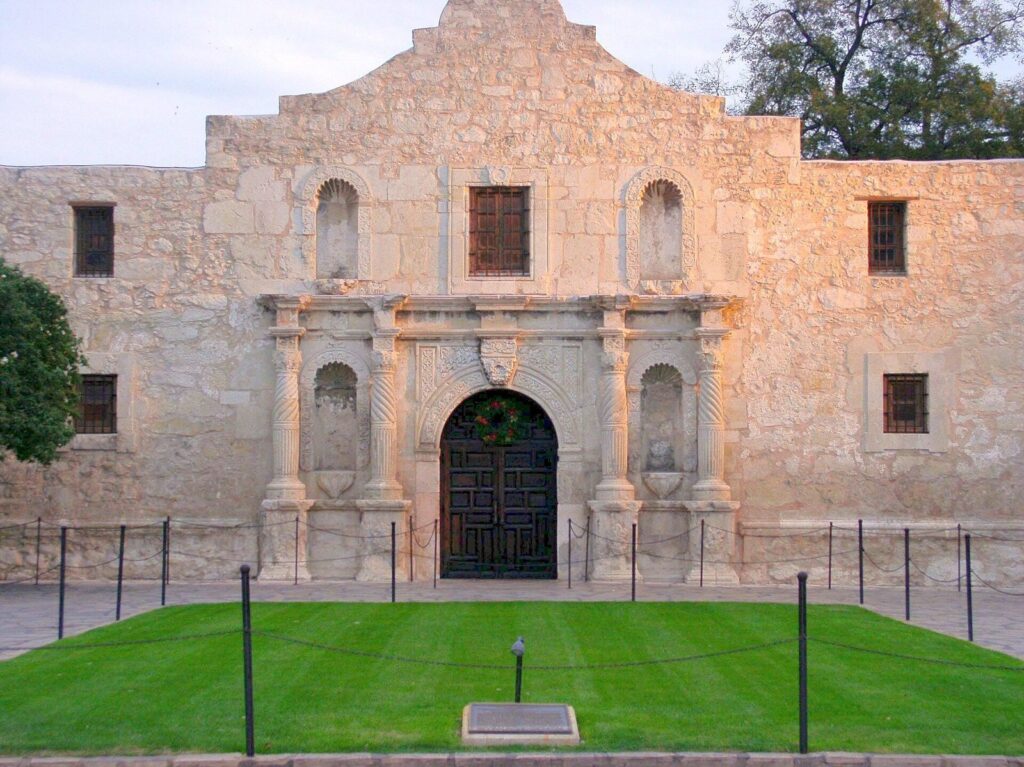
The Alamo San Antonio remembers is a 13-day siege that ended before dawn on March 6, 1836. The Alamo you’ll actually visit is a compact historic site in the middle of downtown: a limestone mission church, the Long Barrack, shaded gardens and a paid exhibit of artifacts, open 9 a.m. to 5:30 p.m. every day except December 25. The church is free, but you need a free timed ticket. Most people see the church and grounds in 30 minutes to an hour; add the Alamo Exhibit or a guided tour and it’s closer to two hours.
This guide is for first-time visitors deciding what to book, how long to stay and what to skip. The caveat in 2026 is construction. Alamo Plaza is closed to traffic, Houston Street is fenced off for a museum that isn’t due until 2028, and preservation work means you enter and leave the church by its front doors. The site is open and worth the stop; just expect fences, detours and some noise. Details were checked September 23, 2026 against the Alamo’s own site, the Texas State Historical Association and the other official sources listed at the end.
| At a glance | The Alamo |
|---|---|
| Cost | Church, Long Barrack and grounds free; Alamo Exhibit $15 for adults; tours $20 to $48 |
| Hours | 9 a.m. to 5:30 p.m. daily; closed December 25 |
| Time needed | 30 to 60 minutes for the church and grounds; about 2 hours with the exhibit or a tour |
| Time outdoors | The plaza, gardens and grounds are outside; the church, Long Barrack and exhibit are indoors |
| Best time to go | The 9 a.m. opening, especially from June to September |
| Book ahead? | Reserve the free church ticket online; book paid tours ahead on busy days |
| Parking | None on site; use nearby public lots and garages |
What’s on the Alamo grounds?
The site is smaller than many first-timers expect, hemmed in by downtown hotels and shops, and it rewards slowing down. Here’s what’s there.
The Alamo Church
The church is the building on every postcard and the reason most people come. It was built as the church of Mission San Antonio de Valero, which was founded on May 1, 1718 and moved to this site in 1724, and in 1836 it became part of the fort. Its famous curved roofline, the “hump,” wasn’t there during the battle: the U.S. Army added it in 1850. Inside, the mood is closer to a memorial than a museum. People died here, and a lot of visitors come for exactly that reason, so keep your voice down and your phone on silent.
Plan it: free with a timed ticket, reserved online or picked up at an Alamo Welcome Center; if you arrive outside your slot during open hours you’ll still be let in; allow 15 to 30 minutes; during the current preservation work, you enter and leave through the front doors; no flash photography.
The Long Barrack
North of the church stands the Long Barrack, the other building that survives from the mission. It was part of the convento, the mission’s living and working quarters, and it became part of the defenses in 1836. The Alamo lists it as free and wheelchair accessible. It gets a fraction of the church’s attention, which is a shame, because it’s the building that shows you the mission was a working community and not only a church.
Plan it: free; no timed ticket needed; allow 10 to 20 minutes.
The Alamo Gardens and the Living History Encampment
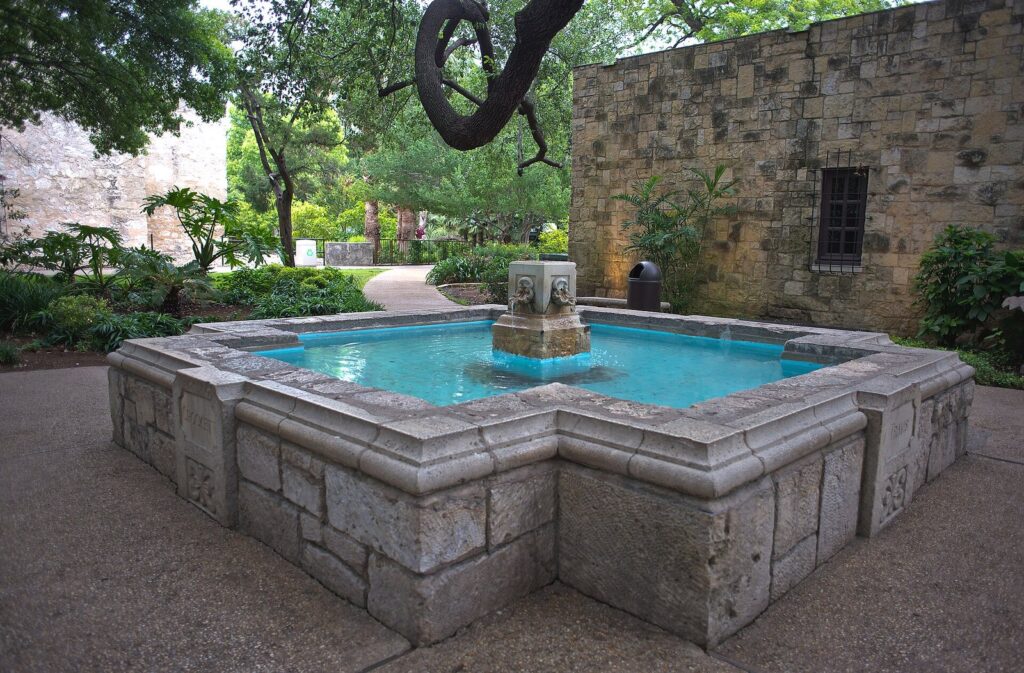
The Alamo Gardens are the shadiest part of the site, with paths, a fountain and big old trees, and on a hot morning they’re where you’ll want to linger. The Living History Encampment offers hands-on demonstrations of daily life in the 1830s. It’s the best thing on the grounds for children who aren’t ready for a museum, and it’s not only for children. Nearby you’ll find a full-size replica of the 18-pounder cannon fired during the 1836 battle, and a sculpture trail of bronze statues of figures from the Alamo’s history.
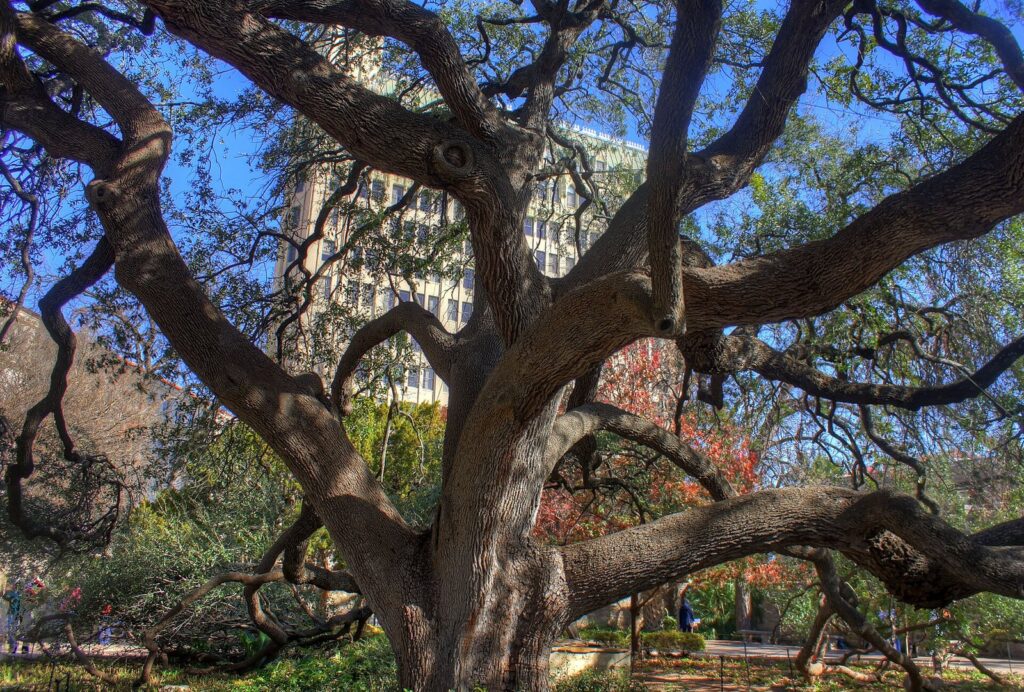
Plan it: free; open during site hours; demonstration times vary by day, so ask at a Welcome Center when you arrive; allow 20 to 30 minutes.
The Alamo Exhibit and the Phil Collins Collection
The paid part of the visit is the Alamo Exhibit in the Ralston Family Collections Center. It shows more than 500 artifacts, including the collection that the musician and historian Phil Collins gave to the State of Texas, and admission includes Surrounded!, an augmented-reality experience. From September 4, 2026 to March 31, 2027, a temporary exhibit, Sons of ’76, runs alongside it. If you care about the history at all, this is where the Alamo stops being a building and becomes a story told through things people carried and fought with, and at $15 for adults it’s the best-value add-on on the site.
Plan it: adults $15, children $11, seniors and military $13; open 9 a.m. to 5 p.m., last entry 4 p.m.; Sons of ’76 is included in the tour packages or $15 on its own; allow 45 to 60 minutes.
The Cenotaph
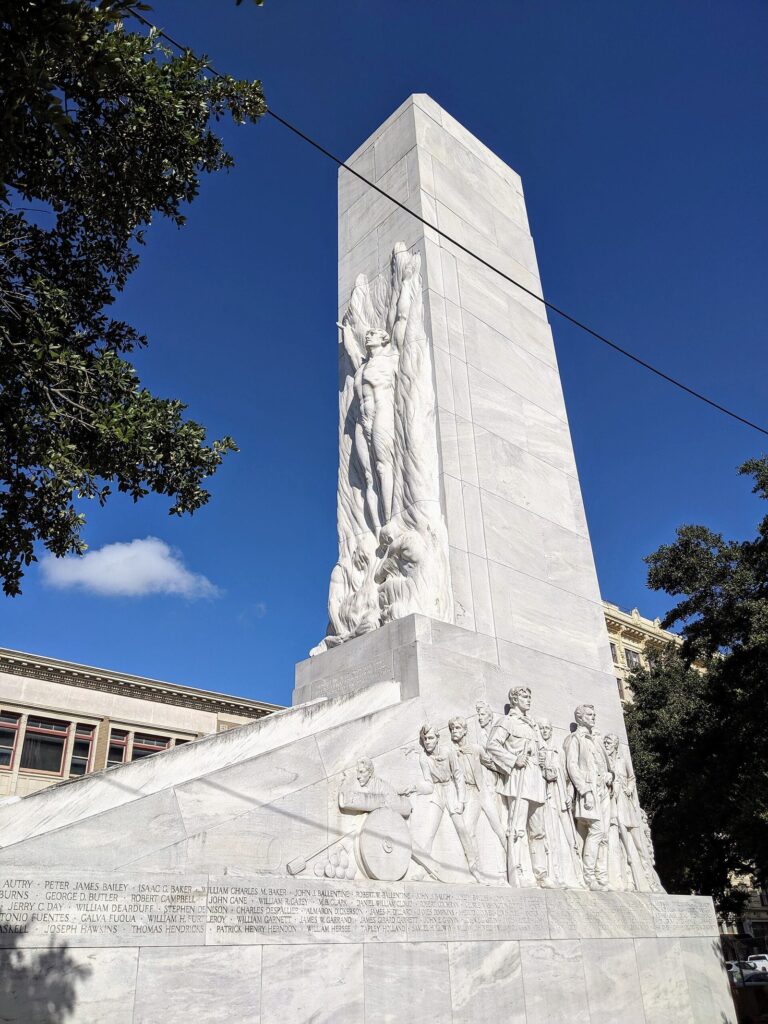
On Alamo Plaza stands the Cenotaph, the tall monument carved with figures of the defenders. Plans to move it were dropped. Instead it was restored where it stands and rededicated on November 11, 2025, with new landscaping and lighting still to come in 2026. It’s outdoors, it’s free, and it’s the easiest thing to photograph without a crowd in the frame first thing in the morning.
Free visit, self-guided or guided tour: which is worth it?
The free visit covers the church, the Long Barrack, the gardens and the grounds, and for plenty of people that’s enough. The real question is whether to pay for context. Here’s how the options compare at prices checked September 23, 2026.
| Option | Adult price | What you get | Time | Verdict |
|---|---|---|---|---|
| Free visit | $0 with a timed ticket | The church, Long Barrack, gardens and grounds | 30 to 60 minutes | A good first look; the context comes from signs and your own reading |
| Alamo Exhibit only | $15 (child $11, senior and military $13) | 500+ artifacts, the Phil Collins Collection and Surrounded! | Another 45 to 60 minutes | For people who like objects more than narration |
| A Line in the Sand, self-guided | $20 (child, senior and military $18) | An audio tour narrated by Ray Benson, plus the exhibit and the church | About 2 hours at your own pace | The best value: $5 more than the exhibit alone buys you the story |
| Remember the Alamo Guided Tour | $48 (child 12 and under $38, senior and military $43) | A 45-minute guided tour, plus the church, the exhibit and Surrounded! | About 2 hours in all | Worth it if you want a person to answer questions; steep for a family |
| Young Texans Tour | $48 (child $38) | A daily morning tour | 9:45 to 10:45 a.m. | Read the Alamo’s description before you book |
| Private tour | $60 per person for 15 to 60 people, or $900 flat for a smaller group | About 45 minutes with a guide | 45 minutes | For reunions, school groups and history clubs |
For most first-time visitors, A Line in the Sand is the one to buy. The audio tour lets you move at your own speed, stand in the gardens when it’s shady and skip what doesn’t interest you, and it bundles in the exhibit you’d probably want anyway. The guided tour makes sense for someone who learns better by asking questions, and it runs on a fixed schedule, with departures from 9:30 a.m. to 3 p.m. For a family of four, though, the guided tour runs well over $150, and the self-guided option is less than half that.
If you’re short on time, don’t pay for anything. See the church first thing, walk the gardens, and spend your money on something else. That’s a perfectly good Alamo visit, and nobody is checking.
Three ways to plan your Alamo visit
- The 45-minute stop: a 9 a.m. timed ticket, the church, the Long Barrack, a loop of the gardens and the Cenotaph on your way out. Free.
- The history morning: the church at 9 a.m., then A Line in the Sand through the exhibit, with the audio tour carrying you through the grounds. Finish before 11 a.m., when the plaza heats up, and walk down Paseo del Alamo to the shaded River Walk. About 2 hours and $20 per adult.
- With kids: the Living History Encampment and the replica cannon first, the church second while attention lasts, and Surrounded! in the exhibit if they’re old enough. Then a 12-minute walk to Hemisfair’s Yanaguana Garden playground and splash pads. About 90 minutes on site.
How should you plan the day?
Get the free church ticket first
Reserve a free timed ticket for the church on the Alamo’s website, or pick one up at a Welcome Center when you arrive. The system is there to protect the building, not to turn people away: if you show up outside your slot during open hours, the Alamo says you’ll still get in. Paid tours and the exhibit are booked separately. On a spring break weekday or a holiday weekend, reserve the church and any paid experience before you leave your hotel.
Beat the heat by going early
Go at 9 a.m. The plaza, gardens and grounds are outdoors, and from June through August San Antonio’s average high is 92 to 96°F, with about 18 days a year reaching 100°F. An early start gets you the church while the morning is still bearable and puts you in the air-conditioned exhibit as the heat builds. From October to April you can take your time in the gardens at any hour. Late afternoon works too, but mind the cutoffs: the exhibit’s last entry is 4 p.m.
| Months | Average high | How to plan an Alamo visit |
|---|---|---|
| January and February | 63 to 68°F | Any hour works; bring a layer for the shaded gardens |
| March to May | 74 to 87°F | Comfortable until May, when mornings become the better bet |
| June to September | 90 to 96°F | Arrive at 9 a.m. and be indoors by 11 a.m. |
| October and November | 72 to 82°F | The most pleasant months to linger outdoors |
Averages are NOAA’s 1991 to 2020 normals for the San Antonio airport. Downtown’s stone and pavement make the plaza feel hotter than the number suggests.
Getting there and parking
The Alamo is at 300 Alamo Plaza, in the middle of downtown, and it’s easiest on foot. From the River Walk, take Paseo del Alamo, the passage that reopened on July 2, 2026 with an elevator and a new Welcome Center. Walking times by street from Alamo Plaza, from OpenStreetMap routing:
| From the Alamo to | Distance | Walk |
|---|---|---|
| La Villita | 0.4 mile | 10 minutes |
| Yanaguana Garden at Hemisfair | 0.6 mile | 12 minutes |
| San Fernando Cathedral | 0.6 mile | 13 minutes |
| Spanish Governor’s Palace | 0.7 mile | 15 minutes |
| Tower of the Americas | 0.7 mile | 16 minutes |
| Market Square | 0.9 mile | 19 minutes |
| The Pearl | 1.5 miles | 33 minutes |
The Alamo has no parking of its own. It points drivers to nearby public lots and garages, which you can reserve through SP+ and ParkWhiz. City garages are free on Thursdays from 5 p.m. to 2 a.m. through the end of 2026, which is lovely for dinner and no help at all for a daytime visit, and St. Mary’s Garage charges $5 after 5 p.m. on weeknights and all weekend. A VIA bus fare is $1.30, or $2.75 for a day pass. With the plaza closed to cars, a rideshare will drop you a short walk away.
Accessibility
The church, the Long Barrack and the gift shop are wheelchair accessible. The church’s usual exit has stairs, so staff bring wheelchair users out through the front door, which during the current preservation work is everyone’s entrance and exit anyway. Only ADA service animals are allowed. For visual or hearing accommodations, contact the Alamo before your visit. Coming up from the river, the Paseo del Alamo elevator saves you the River Walk’s stairs.
Rules worth knowing
- Last entry: the Alamo’s visit page says 30 minutes before closing and its FAQ says 15. Be through the gate by 5 p.m. and the question never comes up.
- Cutoffs inside: the Collections Center’s last entry is 4 p.m., and audio tour devices are handed out only until 4 p.m.
- Photos: no flash inside any building, no drones anywhere on the grounds, and professional filming needs a permit.
- Animals: no pets; ADA service animals only.
- Facilities: restrooms are on site, and the gift shop is open 9 a.m. to 5 p.m.
What mistakes do first-time visitors make?
- Paying for a free ticket. Search results for Alamo tickets include resellers selling tour bundles. The church ticket is free from the Alamo’s own website or a Welcome Center, and the Alamo’s paid experiences are sold there too.
- Driving to the door. Alamo Plaza is closed to vehicles, and the Alamo has no parking. Park a few blocks away or walk from your hotel.
- Arriving at 3:30 p.m. for the full visit. The exhibit’s last entry and the audio tour cutoff are both 4 p.m. Late arrivals get the church and grounds, and that’s about it.
- Expecting a fort. What survives is a church and one long stone building, surrounded by a modern downtown. The battlefield itself lies under the streets and plaza around you, which is exactly why the new museum and the plaza redesign exist.
- Doing it at noon in July. The outdoor parts of the visit are the ones with no air conditioning. Go at 9 a.m.
- Treating it as a photo stop. Take your picture of the facade, then go inside and read. The church is small, but what happened in and around it isn’t.
What is the Alamo Plan construction changing?
The Alamo is partway through the Alamo Plan, a multiyear rebuild of the site and the plaza around it. Here’s where things stood in September 2026:
- Alamo Plaza is closed to vehicles.
- Houston Street is fenced for the museum build, with the north sidewalk between Losoya and Alamo streets open to pedestrians. Street work starts in January 2027, after which that block becomes pedestrian-only.
- Paseo del Alamo, the link to the River Walk, reopened on July 2, 2026 with a Welcome Center and an elevator.
- The church is open, with entry and exit through the front doors during preservation work at the rear. Major preservation work on the church was due to start later in 2026.
- The Cenotaph was restored in place and rededicated on November 11, 2025.
- The Alamo Visitor Center and Museum is scheduled to open in spring 2028, although the Alamo’s FAQ still says 2027.
Is it still worth visiting during construction? Yes. The church, the Long Barrack, the gardens and the exhibit are all open, and the fencing is mostly around the edges. If you’re wondering whether to wait for the new museum, don’t: the church is the reason to come, and it’s here now.
Is the Alamo good for kids?
For school-age kids, yes, in small doses. The Living History Encampment and the replica cannon are the parts they’ll remember. The church is quiet and dim, which holds most young children for about five minutes, and that’s fine; it’s still worth those five minutes. Surrounded!, the augmented-reality piece included with the exhibit, is the most kid-friendly part of the paid visit, and children’s prices are $11 for the exhibit and $18 for A Line in the Sand. Plan a reward nearby: Hemisfair’s Yanaguana Garden playground is a 12-minute walk, and its splash pads run 9 a.m. to 9 p.m. from March to October.
What really happened at the Alamo?
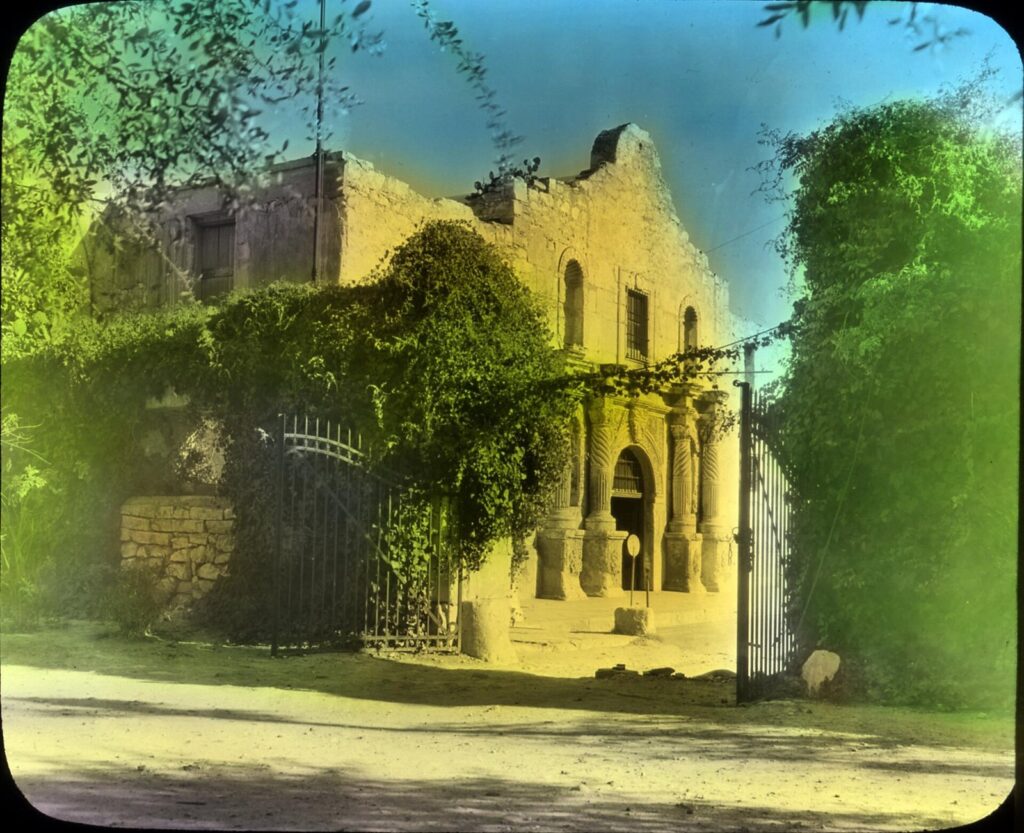
Separate what’s documented from what’s legend and the story gets more interesting, not less.
A mission before it was a fort
The Alamo began as Mission San Antonio de Valero, founded on May 1, 1718 and moved to its present site in 1724. For most of the 1700s it was a mission community where Coahuiltecan and other Indigenous people lived and worked under Spanish Franciscan authority, and the story of the site starts with them, not with 1836. The name Alamo came later, probably from a Spanish cavalry company from Álamo de Parras, in Coahuila, that was stationed in the old mission in the early 1800s.
The siege and the battle
Santa Anna’s army reached Béxar, as the town was then known, on February 23, 1836, when the garrison numbered about 150. On February 24, William B. Travis wrote his famous letter promising “I will never surrender or retreat” and signing off “Victory or Death”; the same day, James Bowie fell ill. Thirty-two men from Gonzales got through the lines on March 1. Around 5 a.m. on Sunday, March 6, about 1,800 Mexican troops made the final assault. The official list of Texan dead has 189 names, and continuing research may push the total as high as 257. Mexican killed and wounded numbered about 600.
The people the old story left out
Tejanos served in the siege as defenders, couriers and noncombatants, and most of the people who survived the final assault were Tejanos; no one knows exactly how many fought. Joe, a man enslaved by Travis, fought on March 6 and survived, and his account became the basis of the traditional story of the battle. Susanna Dickinson and her infant daughter, Angelina, survived too. Slavery runs through the wider story: Mexico had moved to restrict it, and the Republic of Texas protected it in its 1836 constitution.
Legend versus the record
Two famous scenes are shakier than the movies suggest. The story of Travis drawing a line in the sand and asking his men to cross it surfaced in print decades after the battle, told secondhand, and historians treat it as legend. How Davy Crockett died is still argued over: as many as seven defenders survived the fighting and were then executed, and many historians count Crockett among them. After the Alamo fell, “Remember the Alamo” became the battle cry at San Jacinto on April 21, 1836, where the Texian army defeated Santa Anna.
From battlefield to shrine
The ruins didn’t become a shrine overnight. After Texas joined the United States, the U.S. Army used the church as a supply depot, which is when the hump went up. The State of Texas bought the church in 1883. The Long Barrack spent years as a store before the state acquired it in 1905, largely with money advanced by Clara Driscoll, and for more than a century the Daughters of the Republic of Texas looked after the site. Today the Alamo Trust, a nonprofit, manages it for the state. In 2015, UNESCO inscribed the Alamo and the four missions to its south together as the San Antonio Missions World Heritage Site.
What should you pair with the Alamo?
The Alamo is a morning, not a day. These are the natural pairings, all within a short walk or drive:
- The River Walk: walk down Paseo del Alamo to the loop, the shadiest walk downtown. Our guide to the San Antonio River Walk compares the downtown loop, the Museum Reach and the Mission Reach.
- La Villita and Hemisfair: 10 and 12 minutes on foot, both free, with the Tower of the Americas at Hemisfair if you want the view.
- San Fernando Cathedral and The Saga: 13 minutes on foot. The free projection show on the cathedral runs Tuesday to Sunday at 9 p.m.
- The four missions: Mission Concepción is 3.3 miles away, about 7 minutes by car without traffic. See the comparison below before you choose.
More history close by
If the Alamo leaves you wanting more of the story, four smaller sites fill in parts it can’t. None takes more than an hour or two, and most cost less than the Alamo Exhibit.
Spanish Governor’s Palace. A 15-minute walk west, this low stone building on Military Plaza housed the commanders of the Spanish presidio in the 1700s, and it’s the best place downtown to see how colonial officials lived.
Plan it: Tuesday to Saturday 9 a.m. to 5 p.m. and Sunday 10 a.m. to 5 p.m., closed Monday; adults $5, seniors 60 and over, military and ages 7 to 13 $3, under 7 free.
Casa Navarro State Historic Site. The home of José Antonio Navarro, a Tejano leader who signed the Texas Declaration of Independence, on the west side of downtown. It tells the Tejano side of the Revolution that the Alamo only touches.
Plan it: Tuesday to Sunday from 10 a.m., closing at 4 or 4:30 p.m. (the Texas Historical Commission’s own pages disagree), closed Monday; adults $5, seniors, veterans and teachers $3, ages 6 to 17 $2, families $8.
Institute of Texan Cultures. UTSA’s museum of the many peoples who made Texas reopened on January 29, 2026 in a temporary home at 111 W. Houston Street, in the Frost Tower, where it expects to stay for about five years.
Plan it: Thursday to Sunday, 10 a.m. to 4 p.m.; adults $10.
Briscoe Western Art Museum. Art and history of the American West, on the River Walk. It’s the priciest of the four and the one to choose if you like paintings and saddles more than documents.
Plan it: Thursday 10 a.m. to 8 p.m. and Friday to Monday 10 a.m. to 5 p.m., closed Tuesday and Wednesday; adults $16, seniors, veterans and students $14, 12 and under and active military free; free for Bexar County residents on the first Sunday of the month.
For everything else in the city, from museums to theme parks, see our shortlist of things to do in San Antonio.
The Alamo or the missions: which should you prioritize?
San Antonio has five Spanish colonial missions, and the Alamo is the only one the National Park Service doesn’t run. If you have time for only one mission visit, the choice depends on which story you came for.
| The Alamo | The four national park missions | |
|---|---|---|
| Run by | The Alamo Trust, for the State of Texas | The National Park Service; each church is also an active Catholic parish |
| Cost | Free church with a timed ticket; paid exhibit and tours | Free, with free parking |
| Hours | 9 a.m. to 5:30 p.m.; closed December 25 | 9 a.m. to 5 p.m., grounds sunrise to sunset; closed Thanksgiving, Christmas and New Year’s Day |
| Where | Downtown, on foot from most hotels | 3 to 12 miles south by road; you need a car or bike, or VIA Route 42 for the two nearest |
| What you’ll come away understanding | The 1836 siege and the Texas Revolution | What a Spanish mission was and who lived in it |
| Extras | The Alamo Exhibit and the Phil Collins Collection | A free 23-minute film at the Mission San José visitor center and free ranger programs |
Our honest take: the Alamo is the more famous stop, but Mission San José is the better introduction to mission life, because so much more of its compound still stands. Do both on different mornings if you can: the Alamo at 9 a.m. one day, and San José at 9 a.m. the next, when the free film and the 10 a.m. ranger walk give you the whole picture before the heat sets in.
The Alamo FAQ
Is the Alamo free?
Yes. The church, the Long Barrack and the grounds are always free, though the church needs a free timed ticket. You pay only for extras: the Alamo Exhibit ($15 for adults), A Line in the Sand ($20) and guided tours from $48. There’s no Alamo parking lot, so budget for a nearby garage or come on foot.
Can you just show up at the Alamo?
Yes. You can walk the grounds and gardens without a ticket, and you can pick up a free church ticket at a Welcome Center on arrival. Reserving online saves time, and if you arrive outside your reserved window during open hours, the Alamo still admits you. Paid tours can sell out on busy days, so book those ahead.
Can you take pictures inside the Alamo?
The Alamo’s rules ban flash photography inside its buildings and drones anywhere on the grounds, and professional filming needs a permit. Outdoors, photograph freely. For a clean shot of the church facade, arrive at 9 a.m., before the plaza fills, and remember that construction fencing may be in the frame while the work continues.
Who runs the Alamo?
The Alamo is owned by the State of Texas and managed by the Alamo Trust, a nonprofit. It isn’t part of the national park: San Antonio Missions National Historical Park covers the four missions to the south. Together, the Alamo and those four missions make up the San Antonio Missions World Heritage Site, inscribed in 2015.
Can you bring a dog to the Alamo?
No. Pets aren’t allowed on the grounds or in the buildings; only trained ADA service animals are welcome. If you’re traveling with a dog, the downtown River Walk allows leashed dogs, so one person can walk the river while the other tours the church, then swap.
Is the Alamo open on holidays?
Yes, every day of the year except December 25, from 9 a.m. to 5:30 p.m. Holiday weekends are busy, so reserve your church ticket and any tour ahead and arrive at opening. The national park’s four missions close on Thanksgiving, Christmas and New Year’s Day, so if you’re pairing the two over a holiday, put the Alamo on the day the missions are shut.
Is the Alamo worth visiting?
Yes, with realistic expectations. It’s small, it’s busy, and in 2026 it’s surrounded by construction. But standing inside a church that was part of the fort in 1836 is worth half an hour of anyone’s trip, and the exhibit’s artifacts give the story real weight. Go early, pay for the audio tour if you want context, and leave time for the River Walk afterward.
Related San Antonio Guides
- San Antonio River Walk Guide: which of the three reaches to walk after the Alamo, where the elevators are and when the heat allows it.
- Things to Do in San Antonio: the city-wide shortlist, from the missions and the Pearl to museums and theme parks.
- Where to Stay in San Antonio: the best bases for walking to the Alamo, and what downtown parking and hotel tax add to the bill.
- San Antonio Itineraries: where the Alamo fits in a one-, two- or three-day trip, with heat and rain swaps.
Sources and How We Checked
This guide was checked on September 23, 2026 and is compiled from the operators, agencies and historians listed below, not from other travel lists; it describes the site from those sources and claims no first-hand visits.
- The Alamo (Alamo Trust): Visit, FAQs, Remember the Alamo Guided Tour, A Line in the Sand, Young Texans Tour, Private tour, Alamo Collections Center, Sons of ’76
- The Alamo Plan: Construction news, September 2026, August 2026, July 2026, Alamo Visitor Center and Museum, Cenotaph restored and rededicated
- History: The Alamo: Mission Valero, The Alamo: Battle and Revolution, Texas State Historical Association Handbook of Texas: Alamo, Battle of the, Tejanos and the Siege and Battle of the Alamo, Joe
- National Park Service: World Heritage designation
- City of San Antonio: Affordable Parking, Hemisfair
- Nearby: La Villita, Main Plaza: The Saga, VIA fares
- Weather: NOAA monthly normals, NOAA annual normals, San Antonio airport
- Walking and driving times: OpenStreetMap routing from Alamo Plaza
San Antonio Tourism Guide is an independent publication. We are not affiliated with Visit San Antonio, the City of San Antonio, the Alamo or any attraction listed here, and no one paid to be included.
Photo Credits
- The Alamo church facade: photo by KelliMays, Wikimedia Commons (CC BY-SA 4.0)
- Fountain in the Alamo Gardens: photo by Esmithiii2003, Wikimedia Commons (CC BY-SA 4.0)
- Live oak in the Alamo Gardens: photo by Yinan Chen, Wikimedia Commons (Public Domain)
- The Alamo Cenotaph: photo by Eden, Janine and Jim from New York City, Wikimedia Commons (CC BY 2.0)
- Hand-colored lantern slide of the Alamo: photo by OSU Special Collections & Archives : Commons, Wikimedia Commons (No restrictions)