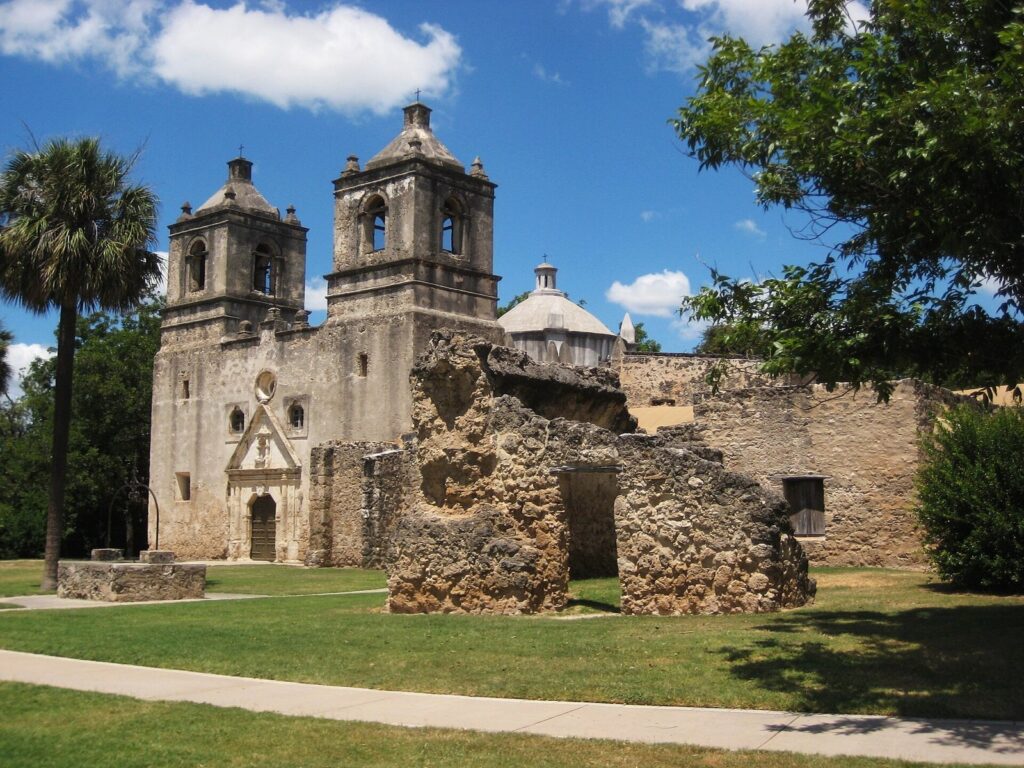
The San Antonio Missions are four Spanish colonial missions strung along the San Antonio River south of downtown: Concepción, San José, San Juan and Espada. The National Park Service runs them as San Antonio Missions National Historical Park. Admission and parking are free, the missions are open 9 a.m. to 5 p.m. every day but three holidays, and each church is still an active Catholic parish. Together with the Alamo, they make up Texas’s only UNESCO World Heritage Site. You can see one mission in 90 minutes, two in a morning, and all four in a half day by car or e-bike. Public transit, though, reaches only the first two.
This guide is for visitors deciding how many missions to see and how to get between them. It lays out one-, two- and four-mission routes by car, bike and bus, with times, costs and what each mission does best. The caveat is heat: the missions and the trail between them are mostly outdoors, with little shade on long stretches, so from May to September start at 9 a.m. and finish by noon. Hours, programs, transit and accessibility were checked September 23, 2026 against the National Park Service, VIA Metropolitan Transit, San Antonio BCycle and the other official sources listed at the end.
| At a glance | San Antonio Missions National Historical Park |
|---|---|
| Cost | Free admission and free parking at every mission |
| Hours | 9 a.m. to 5 p.m. daily; grounds sunrise to sunset; closed Thanksgiving, Christmas and New Year’s Day |
| Time needed | 90 minutes for San José alone; 3 to 4 hours for all four by car; half a day or more by bike |
| Time outdoors | Most of it; the visitor center and the churches are the main indoor stops |
| Best time to go | 9 a.m., October to April; before noon from May to September |
| Book ahead? | No; ranger programs are free and first come, first served |
| Transit | VIA Route 42 serves Concepción and San José only |
Which of the four missions should you visit?
Each mission has its own character, and they’re worth seeing in order from north to south. Drive times are free-flow OpenStreetMap routing from Alamo Plaza.
| Mission | From the Alamo | What stands out | Time needed | Bus | Bike share |
|---|---|---|---|---|---|
| Concepción | 3.3 miles, 7 minutes | The church dedicated in 1755, with traces of its painted decoration | 30 to 45 minutes | VIA Route 42 | Yes |
| San José | 5.9 miles, 11 minutes | The visitor center, film and ranger walks; the Rose Window; the walled compound | 60 to 90 minutes | VIA Route 42 | Yes |
| San Juan | 7.6 miles, 14 minutes | A white bell-wall church and short trails through the old farmland | 30 to 45 minutes | None | Yes |
| Espada | 11.8 miles, 17 minutes | A small stone church with an unusual arched doorway, and the aqueduct nearby | 30 to 60 minutes with the aqueduct | None | Yes, plus Espada Dam |
Mission San José: start here
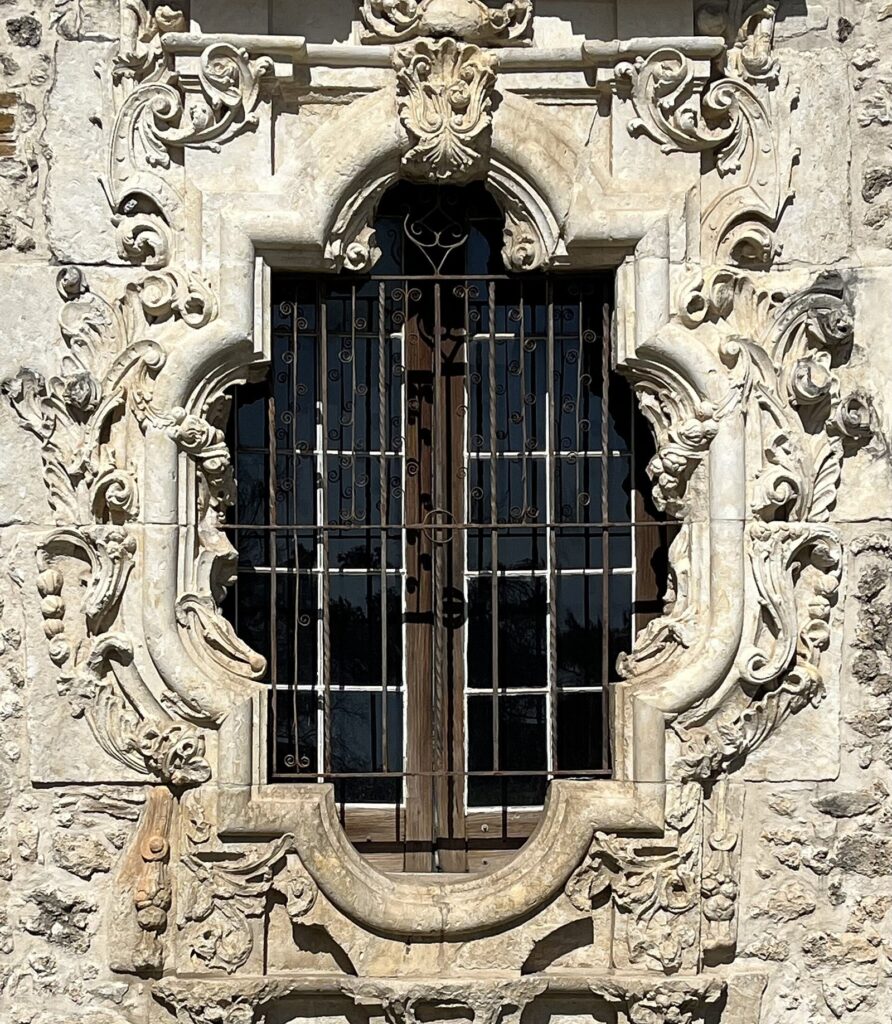
If you see only one mission, make it San José. Founded in 1720, it has the park’s visitor center, the most complete compound, with its walls and rooms around a large plaza, and the Rose Window, a carved stone window widely considered one of the finest pieces of Spanish colonial decoration in the country. The visitor center shows a free 23-minute film, in English on the hour from 10 a.m. to 4 p.m. and in Spanish on the half hour from 10:30 a.m. to 3:30 p.m. Rangers lead free guided walks at 10 and 11 a.m., about 45 minutes long and capped at 50 people.
Plan it: 6701 San José Drive; free; 9 a.m. to 5 p.m.; allow 60 to 90 minutes; VIA Route 42 stops here; BCycle station; free WiFi; the visitor center has 6 accessible parking spaces and an electric-vehicle charger, but its exhibit doorways narrow to 26 to 30 inches.
Mission Concepción: the best-preserved church
Concepción was first founded in East Texas in 1716 and moved to San Antonio in 1731. Its church, dedicated in 1755, is the one that looks most like it did in the 18th century, and inside and out you can still find traces of the painted geometric and religious decoration that once covered it. Facade restoration was under way in 2026, so expect some scaffolding in your photos; the Park Service listed no closures. A ranger gives a talk at 10 a.m.
Plan it: 807 Mission Road; free; allow 30 to 45 minutes; VIA Route 42 stops here; BCycle station; wheelchairs available to borrow at the information desk; 1 van-accessible and 2 accessible parking spaces.
Mission San Juan: the farm mission
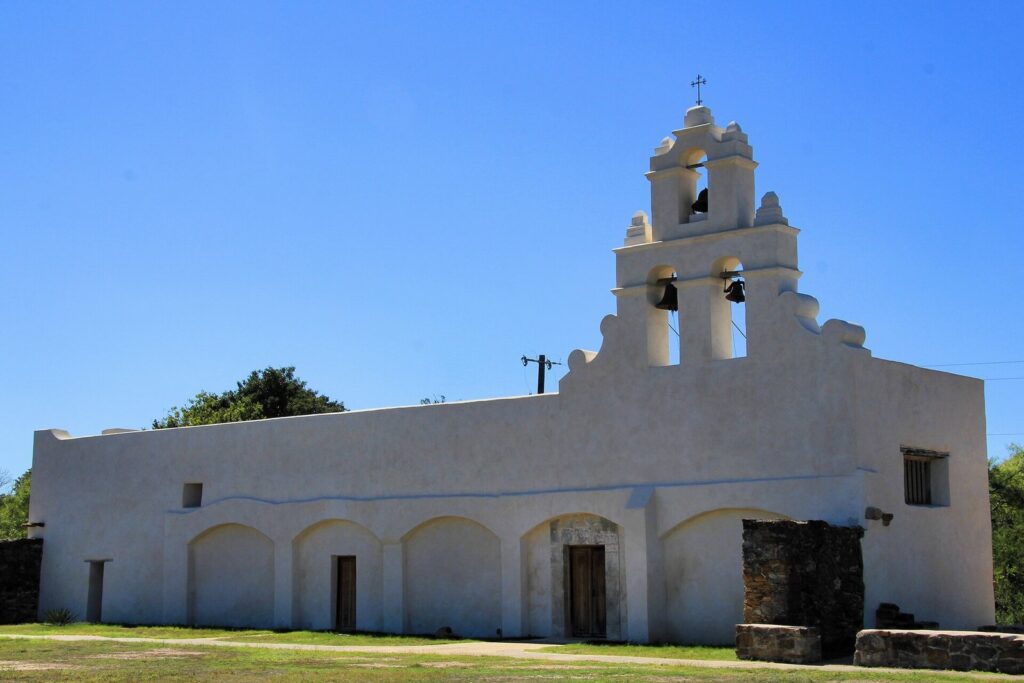
San Juan Capistrano also moved from East Texas in 1731. It’s the quietest of the four and the best place to understand the missions as farms: a 0.2-mile Farm Loop Trail runs through the old fields, and the 0.25-mile Yanaguana Trail, lined with benches, connects the mission to the river trail. Rangers offer a demonstration or tour at 10 a.m. There’s no bus, so come by car or bike.
Plan it: 9101 Graf Road; free; allow 30 to 45 minutes, more if you walk the trails; BCycle station; 6 accessible parking spaces and a 600-foot paved path to the mission; its exhibits were being renovated for accessibility in 2025.
Mission Espada: the southern end
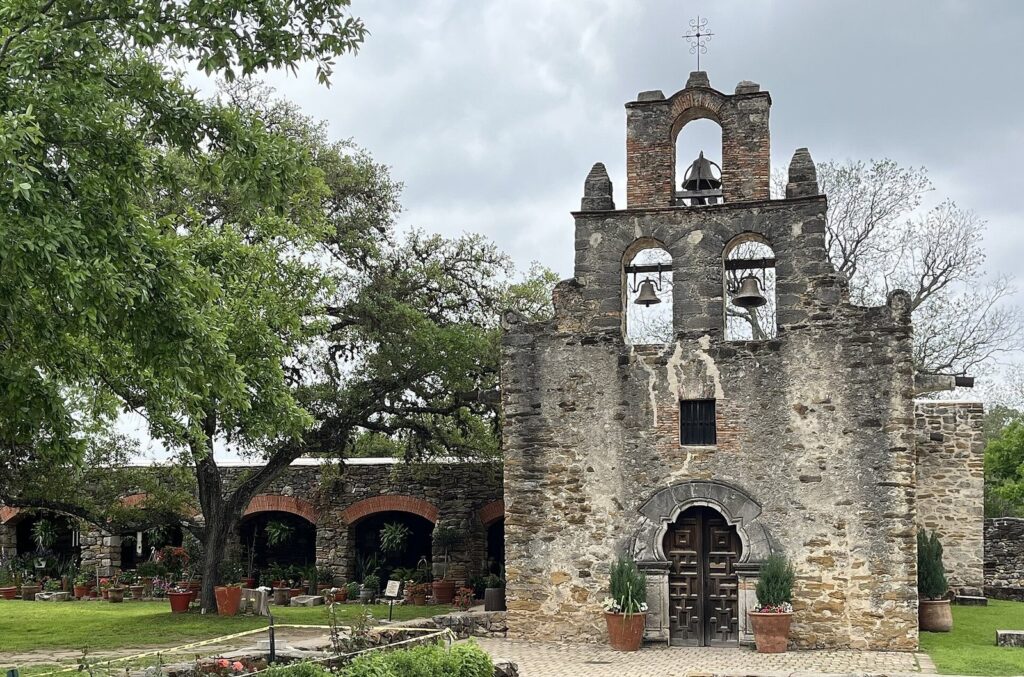
Espada, the southernmost mission, arrived with the others in 1731. Its small stone church has a distinctive arched doorway, and the grounds feel more rural than the others. A ranger-led weaving demonstration runs at 3 p.m. Mission Espada’s old ranch, Rancho de las Cabras, lies well south of the city and is open only on reserved guided programs of about two hours, over dirt and gravel with no restrooms or water.
Plan it: 10040 Espada Road; free; allow 30 minutes, plus 20 for the aqueduct; BCycle station here and at Espada Dam; no bus; 1 van-accessible and 1 accessible parking space.
The Espada Aqueduct and Espada Dam
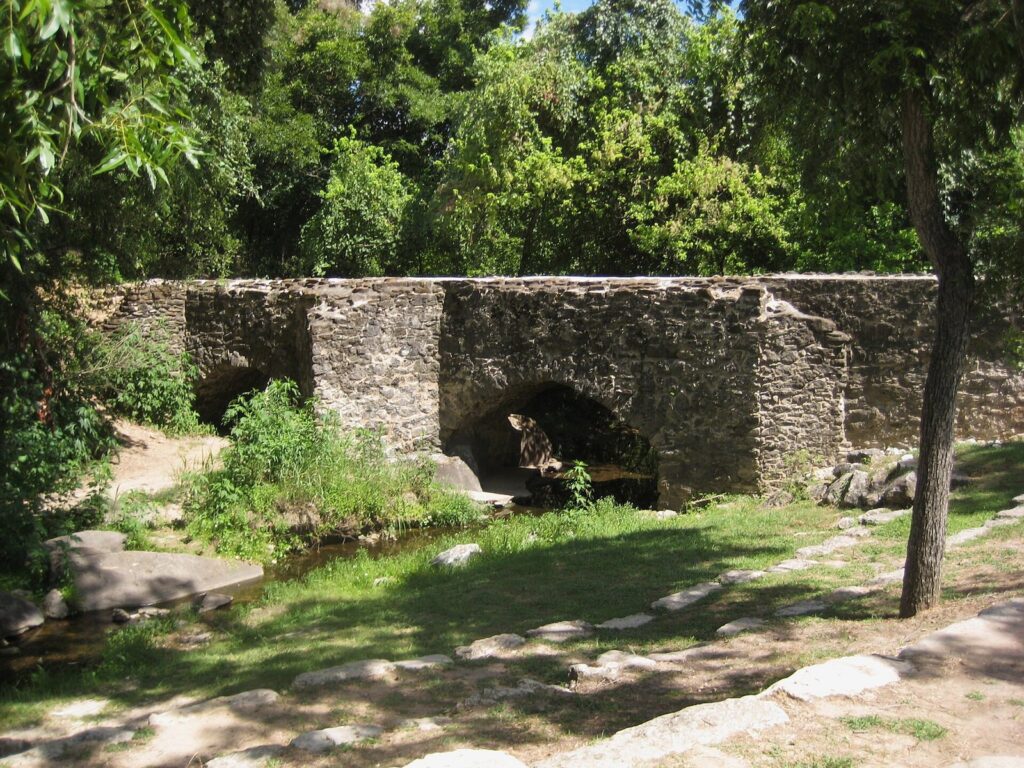
North of Mission Espada, the Espada Aqueduct carries an acequia, an irrigation ditch, over Six-Mile Creek on two stone arches. It was built between 1740 and 1745, water still flows over it, and the Park Service calls it the oldest Spanish aqueduct in the United States. Don’t skip it: it’s the clearest surviving evidence of how the missions actually fed themselves. Espada Dam, on the river nearby, has a BCycle station, but its path drops steeply, at a slope of more than 14 percent, and the Park Service suggests visitors with mobility concerns view it from their cars.
Plan it: free; parking with 1 van-accessible and 11 other spaces; the viewing area is nearly level; open daylight hours.
And the Alamo?
The Alamo began as Mission San Antonio de Valero in 1718, the first of the five, and it’s part of the same World Heritage Site. It isn’t part of the national park, though: it’s owned by the State of Texas and run by the Alamo Trust, with a free timed ticket for the church. Our Alamo visitor guide covers it in full.
Which mission suits you?
- You want the full picture in one stop: San José, for the visitor center, the film, the ranger walk and the largest compound.
- You care about architecture and art: Concepción, for the oldest-looking church and its painted traces, and San José’s Rose Window.
- You want to understand how the missions fed themselves: San Juan’s farm trails and the Espada Aqueduct.
- You want quiet: Espada, at the far end, where the grounds feel most like the countryside.
- You’re traveling with someone who uses a wheelchair: San José’s visitor center and San Juan’s paved path and level trails are the easiest starts.
One naming note: Mission San Juan Capistrano in San Antonio is not the famous California mission of the same name, the one known for its swallows. If you search for directions, add “San Antonio” or use the address, 9101 Graf Road.
How do you get to the missions?
The missions sit 3 to 12 miles south of downtown along the river, and the Park Service provides no transportation between them. You have four options, and they aren’t equal.
| How | Missions you can reach | Cost | All four missions takes | Verdict |
|---|---|---|---|---|
| Car | All four, plus the aqueduct | Free parking | 3 to 4 hours; Concepción to Espada is about 15 minutes by road | The easiest, and the only sensible choice for all four in summer |
| BCycle e-bike | All four, via the river trail | $25 day pass, or $15 for one hour | Half a day or more | The best experience from October to April |
| VIA Route 42 | Concepción and San José only | $1.30 a ride, $2.75 a day pass | Not possible | Fine for the two northern missions |
| On foot | Concepción from downtown; the rest by trail | Free | A full, hot day | Only for strong walkers in cool weather |
By car
Driving is the simplest way to see all four. Every mission has a free lot, and the Espada Aqueduct has its own parking. From Alamo Plaza, Concepción is 7 minutes away, San José 11, San Juan 14 and Espada 17 without traffic. Drive south to Concepción first and work your way down; the Park Service puts Concepción and Espada about 6.5 miles apart, roughly 15 minutes by car.
By bike on the Mission Reach
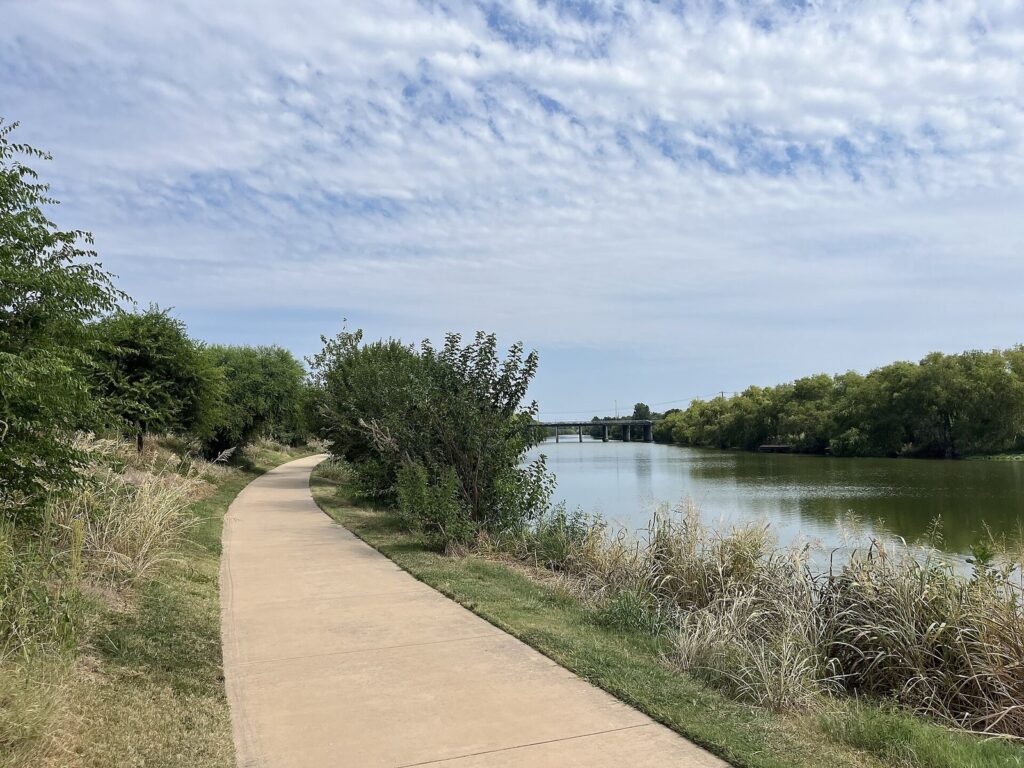
The river trail that links the missions is paved the whole way, and it runs as an out-and-back, not a loop. The Park Service puts each mission about 2 to 3 miles from the next and says there are water fountains and restrooms along the way. San Antonio BCycle, the city’s electric bike share, has stations at all four missions, at Espada Dam and at Confluence Park. A 1-Hour Pass costs $15, and a Day Pass costs $25 for unlimited trips of up to an hour over 24 hours, with $3.25 for each extra 30 minutes. With a Day Pass, dock at each mission while you look around and start a fresh trip when you leave.
The catches are the ones the brochures leave out. Long stretches of the trail have little shade. The Mission Reach closes at dusk, and it can flood after heavy rain; if you can’t see the path, don’t ride it. Ranger programs can be cancelled in extreme heat. Ride from October to April, start by 9 a.m., and carry more water than you think you need.
By bus
VIA Route 42 runs about every 30 minutes and serves Missions Concepción and San José. No bus reaches San Juan or Espada, whatever older guides say. Fares are $1.30 a ride or $2.75 for a day pass, and you can tap a Visa, Mastercard or Discover card or a phone wallet, but not Amex. Route 42 had construction detours posted in 2026 and is being realigned on January 11, 2027, so check VIA’s route page before you ride.
On foot
Concepción is 2.9 miles from the Alamo by street, about an hour’s walk. Walking all four missions is possible on the trail, but it means a long day in the sun and the same distance back, since the trail isn’t a loop. For most people, walking works best as part of a bike or bus plan: take Route 42 to San José and walk the short trails there, or bike and walk the grounds at each stop.
Which mission route should you choose?
Match the route to your time, your transport and the season.
| Route | How | Time | Cost per person | Best for |
|---|---|---|---|---|
| One mission: San José | Car, or VIA Route 42 | 90 minutes | Free, or $2.60 round trip by bus | A short visit, a first taste, a summer morning |
| Two missions: Concepción and San José | Car, VIA Route 42 or bike | 2 to 3 hours | Free, $2.75 bus day pass or $25 bike day pass | A half morning without a car |
| Four missions and the aqueduct by car | Car | 3 to 4 hours | Free | The full story in one morning, any season |
| Four missions by bike | BCycle or your own bike | 4 to 6 hours | $25 day pass | Active travelers, October to April |
One mission in 90 minutes
Arrive at Mission San José at 9 a.m. when it opens, walk the compound and the church, and join the 10 a.m. ranger walk. Catch the film at 11 a.m. if you want the background. By VIA, ride Route 42 there and back. This is the right plan for a hot day, a short trip or anyone who wants the essentials without a car.
Two missions in a morning
Start at Concepción at 9 a.m. for the church, then continue to San José for the 10 or 11 a.m. ranger walk. By car it’s a few minutes between them; by bike it’s roughly 2.5 miles on the trail; by bus both sit on Route 42. You’ll be done by lunch.
All four by car
Concepción at 9 a.m., San José by 10 a.m. for the ranger walk, San Juan around 11:30 a.m., then Espada and the aqueduct before lunch. Allow 3 to 4 hours in all. If you’d rather catch Espada’s 3 p.m. weaving demonstration, flip the order and do San Juan and Espada after lunch, but only in cool weather.
All four by bike
Pick up an e-bike at Concepción or Confluence Park at 8:30 a.m., ride south to San José for the 10 a.m. walk, then on to San Juan and Espada, with the aqueduct as your turnaround. Ride back north, docking as you go. It’s roughly 13 miles round trip between Concepción and Espada, plus any ride from downtown. From May to September, cut it to two missions.
If you want to fit the missions into a wider trip, our San Antonio itineraries pair them with the Alamo, a museum and the Pearl.
The summer version
From June to September, shrink the plan and move it earlier. This is the one we’d follow on a 96°F day:
| Time | Stop | Why |
|---|---|---|
| 8:30 a.m. | Drive to Mission San José | Beat the heat; the grounds open at sunrise |
| 9:00 a.m. | San José compound and church | The coolest hour of the visit |
| 10:00 a.m. | Free ranger walk, then the film in the air-conditioned visitor center | Shade and context before the heat builds |
| 11:15 a.m. | Mission Concepción, 30 minutes | A short, mostly shaded stop inside the church |
| Noon | Done; lunch indoors | Save San Juan, Espada and the aqueduct for a cooler day |
Do you need a guided tour?
No. The best tour of the missions is free: the Park Service’s ranger walk at Mission San José, at 10 and 11 a.m., about 45 minutes with up to 50 people. Add the 23-minute film at the visitor center and a ranger talk at Concepción at 10 a.m., and you’ll understand more than most paid tours can tell you. Commercial tours earn their price mainly by solving transport, since the park provides none between missions and the bus reaches only two. If you don’t have a car and don’t want to bike, a paid tour is the easiest way to see all four; if you do, go on your own.
What else is on the Mission Reach?
The river trail passes a few stops worth adding to a bike day:
- Confluence Park, at 310 W. Mitchell Street where San Pedro Creek meets the San Antonio River. The San Antonio River Foundation opened it in March 2018; its concrete pavilions, shaped like petals, collect rainwater. It’s open sunrise to 11 p.m. and has a BCycle station, so it’s a good place to start a ride south.
- Hot Wells of Bexar County, at 5503 S. Presa Street, where the ruins of old sulfur-spring resorts stand beside the river. It became a county park in April 2019, connects to the Mission Reach trails, and is open 9 a.m. to 9 p.m. in summer and 9 a.m. to 6 p.m. in winter.
- Espada Dam, on the river near the aqueduct, with a BCycle station; its path is steep, so view it from above if you have mobility concerns.
When should you visit the missions?
- Time of day: 9 a.m., when the missions open. The grounds open at sunrise, and mornings are cooler and quieter.
- Season: October to April is best. From June to August the average high is 92 to 96°F, and about 18 days a year reach 100°F; the Park Service notes summer humidity of 40 to 80 percent.
- Day of the week: any day, but ranger programs don’t run on the first Wednesday of the month.
- Holidays: the missions close on Thanksgiving, Christmas and New Year’s Day. The Alamo, by contrast, closes only on December 25.
- Weather: after heavy rain, stay off the Mission Reach trail if it’s flooded. In spring and summer, watch for bees, wasps, fire ants, snakes and scorpions off the paths.
What should you bring?
- Water, more than you think. Refill at the fountains along the trail, but don’t count on every picnic area having water; San José’s doesn’t.
- A hat and sunscreen. Most of each visit is outdoors, and the trail has long unshaded stretches.
- Closed shoes. The compounds mix gravel, brick and flagstone, and fire ants live in the grass.
- Insect repellent from spring through fall, when bees, wasps and mosquitoes are active.
- A charged phone. There’s free WiFi at the San José visitor center and on the mission grounds, and cell service is generally good, with some dead spots.
- Nothing to pay with. Admission and parking are free; you’ll only need a card for BCycle or VIA.
Can you take photos at the missions?
Yes, and the missions are among the most photogenic places in Texas. Morning light is softer and the grounds are emptier at 9 a.m. Inside the churches, be discreet, skip the flash and never photograph a service, a wedding or a funeral. Drones are prohibited in national parks, so leave yours at the hotel. If you want the famous shots, they’re Concepción’s twin towers, San José’s Rose Window and compound walls, San Juan’s white bell wall, Espada’s doorway, and the aqueduct’s arches over the creek.
What should you know about visiting working churches?
All four mission churches are active Catholic parishes, which is part of what makes them different from most historic sites. Couples marry here, families hold funerals here, and Mass is still celebrated every week. The Park Service doesn’t publish Mass times; call the parishes directly: Concepción 210-533-8955, San José 210-922-0543, San Juan 210-534-3161 and Espada 210-627-2064.
A church can close to visitors for a wedding or a funeral, so if one is shut when you arrive, move on and come back. Inside, keep your voice low, don’t photograph people at prayer, and dress as you would for any church. The grounds around each church are open to explore whenever the mission is open.
How accessible are the missions?
Better than many historic sites, with some rough edges. Each mission lends wheelchairs from its information desk or contact station. The main routes through the compounds are mostly paved and flat, but they mix in gravel, brick and flagstone, and some exhibit doorways narrow to 25 or 26 inches. Accessible parking: 6 spaces and an EV charger at San José’s visitor center, 1 van-accessible and 2 standard at Concepción, 6 at San Juan, and 1 van-accessible and 1 standard at Espada. San Juan’s Farm Loop Trail is 0.2 miles with gentle slopes, and its Yanaguana Trail has benches along it. The Espada Aqueduct’s viewing area is nearly level, but Espada Dam’s path is steep. The river trail is paved end to end.
Who built the missions, and who lived in them?
The missions only make sense with the people in them. For thousands of years before the Spanish arrived, the region was home to hundreds of small, culturally diverse Indigenous bands; the Spanish called them Coahuiltecans, after the colonial province of Coahuila y Tejas. Beginning in 1718, Spain founded five mission communities along the San Antonio River: San Antonio de Valero, now the Alamo, in 1718; San José in 1720; and Concepción, San Juan Capistrano and Espada in 1731, all three moved from failed missions in East Texas.
Each mission was a walled community, with living quarters, workshops and storerooms inside and fields and ranches outside. The acequias, like the one the Espada Aqueduct carries, watered the crops. The missions were also instruments of Spanish colonization. Indigenous people who joined them took on Catholicism, Spanish rule and hard labor, often while facing drought, raids and epidemic disease, and their descendants remain part of San Antonio today. The missions were gradually secularized from the 1790s onward, and the churches passed to the parishes that still use them.
The national historical park was created in 1978, taking in the four missions, Espada Dam and the aqueduct. In July 2015, UNESCO inscribed the four missions and the Alamo together as the San Antonio Missions World Heritage Site, the only one in Texas.
| Year | What happened |
|---|---|
| 1716 | Mission Concepción is first founded in East Texas |
| 1718 | Mission San Antonio de Valero, later the Alamo, is founded |
| 1720 | Mission San José is founded |
| 1724 | San Antonio de Valero moves to its present site |
| 1731 | Concepción, San Juan Capistrano and Espada move to the San Antonio River |
| 1740 to 1745 | The Espada Aqueduct is built |
| 1755 | Concepción’s church is dedicated |
| 1790s | Secularization of the missions begins |
| 1836 | The siege and battle of the Alamo, February 23 to March 6 |
| 1978 | San Antonio Missions National Historical Park is created |
| 2010 | The first mile of the restored Mission Reach opens in December |
| 2015 | UNESCO inscribes the five missions as a World Heritage Site in July |
Are the missions good for kids?
For school-age kids, yes, in short doses. The open compounds give them room to move, San José’s walls and rooms are fun to explore, San Juan’s short farm trails suit small legs, and Espada’s 3 p.m. weaving demonstration is hands-on history. Teenagers may enjoy the e-bike version most; check BCycle’s minimum age before you plan a family ride. Each mission has picnic tables, but San José’s picnic area has no drinking water, so bring your own. Keep it to two missions with young children, and plan a pool or a cool indoor stop for the afternoon.
Where should you eat and stay?
The missions are a morning trip from downtown, so most visitors stay in the city center and drive or ride south. Our guide on where to stay in San Antonio compares downtown, the Pearl and King William, the closest of the three to the Mission Reach. For lunch afterward, head back north: our San Antonio food guide covers Market Square, the Pearl and the West Side’s puffy tacos. And to ride the full river from downtown, see our San Antonio River Walk guide to the Mission Reach.
San Antonio Missions FAQ
Are the San Antonio Missions free?
Yes. There’s no entrance fee at any of the four missions, and parking is free at each one, including the Espada Aqueduct. Ranger walks, talks and the 23-minute film at the San José visitor center are free too. You’ll pay only for a bike share pass or a VIA fare if you use them.
Can you take a bus to all four missions?
No. VIA Route 42 serves only Mission Concepción and Mission San José, about every 30 minutes. No bus reaches San Juan or Espada, even though some older guides describe a route that did. For all four, drive or use a BCycle e-bike on the river trail.
How long does it take to see all four missions?
About 3 to 4 hours by car, including 20 minutes at the Espada Aqueduct, or 4 to 6 hours by bike. If you only have half a morning, see San José and Concepción. The Park Service puts Concepción and Espada about 15 minutes apart by car.
Is the Alamo one of the San Antonio Missions?
Yes, historically. The Alamo began as Mission San Antonio de Valero in 1718 and is part of the San Antonio Missions World Heritage Site. But it isn’t in the national park: the State of Texas owns it and the Alamo Trust runs it, and it needs a free timed ticket for the church.
Can you go inside the mission churches?
Yes, during open hours, unless a service, wedding or funeral is under way. All four churches are active Catholic parishes, so be quiet, don’t photograph people at prayer, and call the parish if you want to attend Mass, since the Park Service doesn’t list Mass times.
What happens in bad weather?
The missions stay open, but ranger programs can be cancelled in extreme heat, and the Mission Reach trail can flood after heavy rain. In summer, go early and drive between missions. In a storm, the San José visitor center and the churches are the places to wait it out.
Related San Antonio Guides
- The Alamo Visitor Guide: the fifth mission, its free church ticket and the 2026 construction.
- San Antonio River Walk Guide: the Mission Reach trail from downtown, with shade and access notes.
- San Antonio Itineraries: where a missions morning fits in a one-, two- or three-day trip.
- Things to Do in San Antonio: everything else worth your time in the city.
- San Antonio Food Guide: where to eat after a morning at the missions.
- Where to Stay in San Antonio: the best bases for an early start to the south side.
- San Antonio with Kids: the missions and the rest of the city for toddlers, school-age kids and teens.
Sources and How We Checked
This guide was checked on September 23, 2026 and is compiled from the agencies and operators listed below, not from other travel lists; it describes the missions from those sources and claims no first-hand visits.
- National Park Service, San Antonio Missions: Basic information, Hours, Fees, Directions and transportation, Visitor center, Guided programs, Church information, Hike and Bike Trail, Accessibility, Physical and mobility access, History and culture, Mission Concepción, Espada Aqueduct, World Heritage designation
- VIA Metropolitan Transit: Route 42, Fares
- San Antonio BCycle: Pricing, Station list
- San Antonio River Walk: FAQs (Mission Reach hours and flooding)
- The Alamo: Mission Valero
- Weather: NOAA monthly normals, NOAA annual normals
- Walking and driving times: OpenStreetMap routing from Alamo Plaza
San Antonio Tourism Guide is an independent publication. We are not affiliated with Visit San Antonio, the City of San Antonio, the Alamo or any attraction listed here, and no one paid to be included.
Photo Credits
- Mission Concepción: photo by Liveon001 ©Travis Witt, Wikimedia Commons (CC BY-SA 3.0)
- Rose Window, Mission San José: photo by Michaelluckey, Wikimedia Commons (CC BY 4.0)
- Mission San Juan church: photo by Larry D. Moore, Wikimedia Commons (CC BY 4.0)
- Mission Espada church: photo by Michaelluckey, Wikimedia Commons (CC BY 4.0)
- Espada Aqueduct: photo by Liveon001 ©Travis Witt, Wikimedia Commons (CC BY-SA 3.0)
- Mission Reach hike-and-bike trail: photo by Michaelluckey, Wikimedia Commons (CC BY 4.0)