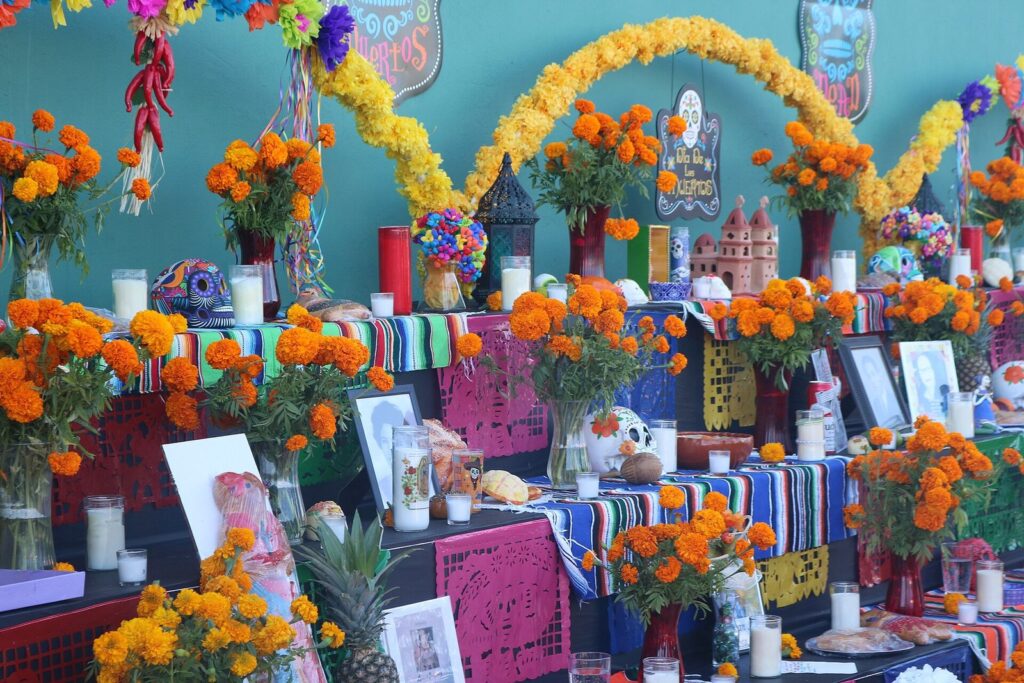
This is our San Antonio Day of the Dead events guide for 2026, and the short version is that the big weekend is October 23 to 25. Muertos Fest fills Hemisfair with more than 80 handmade altars, free, from Friday evening to Sunday night. The Day of the Dead River Parade floats illuminated barges down the River Walk on Friday, October 23, with paid seats and a free standing-room area. Historic Market Square holds its own free celebration that Saturday and Sunday. Around all of it, the Tradition Trail sets giant alebrijes and altars along the downtown River Walk from October 3 to November 2. The holiday itself falls on November 1 and 2, and it’s a time for remembering the dead, not for scaring anyone.
This guide is for visitors who want to see the altars and the processions and understand what they’re looking at, without treating someone’s grief as a photo op. Expect crowds: Muertos Fest alone expects more than 135,000 people over three days. Event details here were checked October 1, 2026 against the organizers’ own pages, the River Walk’s event listings and the City’s Market Square information. For everything else on the city’s calendar, from Fiesta to the holiday lights, see our San Antonio events guide.
| Event | When in 2026 | Where | Cost | Book ahead? |
|---|---|---|---|---|
| Día de los Muertos Tradition Trail | October 3 to November 2 | Downtown River Walk | Free | No |
| Day of the Dead River Parade | Friday, October 23, after dark | Downtown River Walk | Ticketed seats, or free standing room | Yes, for seats; tickets are non-refundable |
| Muertos Fest | October 23, 5 to 11 p.m.; October 24, 10 a.m. to 11 p.m.; October 25, noon to 9 p.m. | Hemisfair | Free | No |
| Día de los Muertos at Historic Market Square | October 24 and 25, 10 a.m. to 6 p.m. | 514 W. Commerce St. | Free to walk in | No |
| Market Square self-guided altar tour | Daily, 10 a.m. to 6 p.m., through November 7 | Historic Market Square | Free | No |
| Día de los Muertos itself | November 1 and 2 | Homes, churches and cemeteries | Not an event | Not applicable |
What is Día de los Muertos, and what isn’t it?
Día de los Muertos is a Mexican tradition of remembering and honoring people who have died. Families build altars, called ofrendas, with photographs, candles, flowers and the foods their loved ones enjoyed, and they visit and decorate graves. The belief behind it is gentle: on these days the dead return to visit, and the living welcome them home. November 1 is traditionally set aside for children who have died and November 2 for adults, matching the Catholic feasts of All Saints’ Day and All Souls’ Day.
That overlap with the church calendar is no accident. The tradition grew from Indigenous Mesoamerican ways of honoring the dead, which met Catholic practice after the Spanish conquest and blended with it. What came out is neither purely one nor the other, and it varies by region and family. The orange marigolds, the copal incense and the skull imagery all have roots older than the colonial church.
What it isn’t is Mexican Halloween. The dates sit side by side and both involve skulls, but Halloween plays with fear, and Día de los Muertos is about love and memory. The skulls are smiling, not menacing. A family altar is closer to a memorial service than to a haunted house, and the mood at even the busiest festival in town carries some of that weight.
Why it’s big in San Antonio
San Antonio is a majority-Latino city with deep Mexican and Tejano roots, and many families here have kept the tradition at home for generations. The large public events are newer. Muertos Fest calls itself one of the largest Day of the Dead celebrations in the United States, the river parade is in its eighth year in 2026, and Texas Public Radio reported in 2025 on the city’s growing reputation as a Day of the Dead destination. Visitors get the public side: festivals, processions, community altars and art. The private side, at kitchen tables and cemeteries, belongs to the families.
What do the altars, marigolds and skulls mean?
An ofrenda can be a single shelf or a structure taller than you, but most share the same vocabulary. Knowing it turns a wall of color into something you can read.
| What you’ll see | What it is | What it means |
|---|---|---|
| Photographs | Pictures of the people being remembered | The heart of the altar: who it’s for |
| Cempasúchil (Mexican marigolds) | Orange and yellow flowers, sometimes as a path of petals | Their color and scent help guide the spirits home |
| Candles | Often many, sometimes one per person remembered | Light to show the way |
| Water and salt | A glass of water and a small dish of salt | Refreshment after a long journey, and purification |
| Pan de muerto | A sweet bread, often decorated with bone shapes | Food for the visitors, shared by the living afterward |
| Favorite foods and drinks | Whatever the person loved, from tamales to a bottle of beer or a soda | A welcome made personal |
| Calaveras | Decorated skulls, including sugar skulls with names written on them | Death treated with familiarity and humor rather than dread |
| Papel picado | Cut tissue-paper banners | Decoration with a reminder built in: the paper is delicate and doesn’t last |
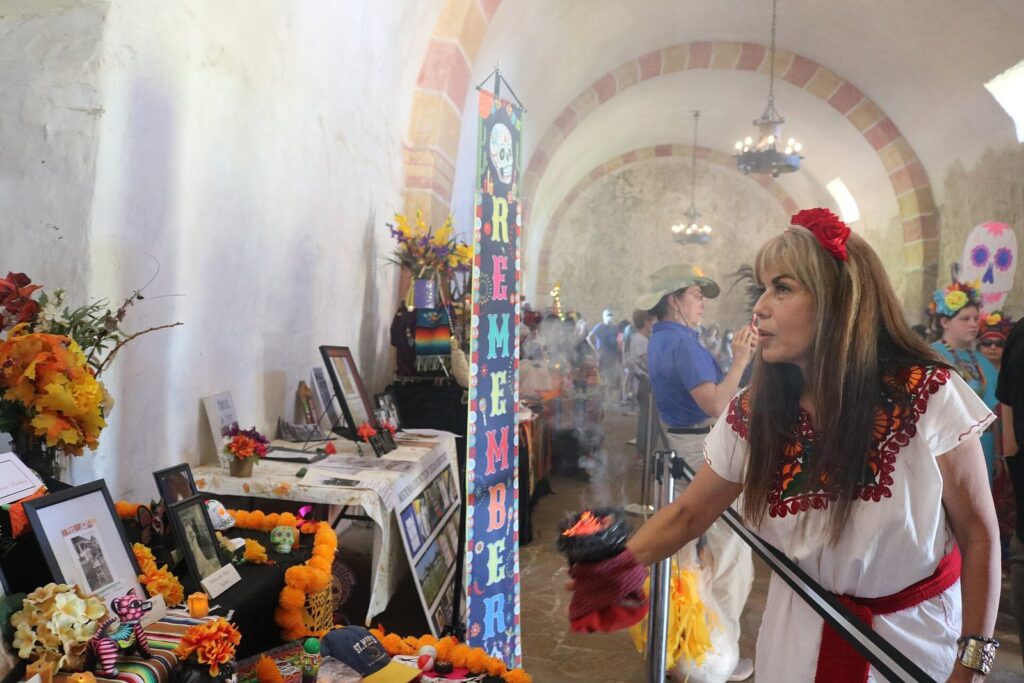
| Copal | A tree resin burned as incense | An Indigenous practice used to cleanse and bless the space |
| Religious images | Crosses, saints, the Virgin of Guadalupe | The family’s faith |
Many altars are built in tiers, often two or three levels, and families explain the levels in different ways. Treat any single “official” meaning with caution; the tradition belongs to the people practicing it, and they don’t all do it the same way.
La Catrina
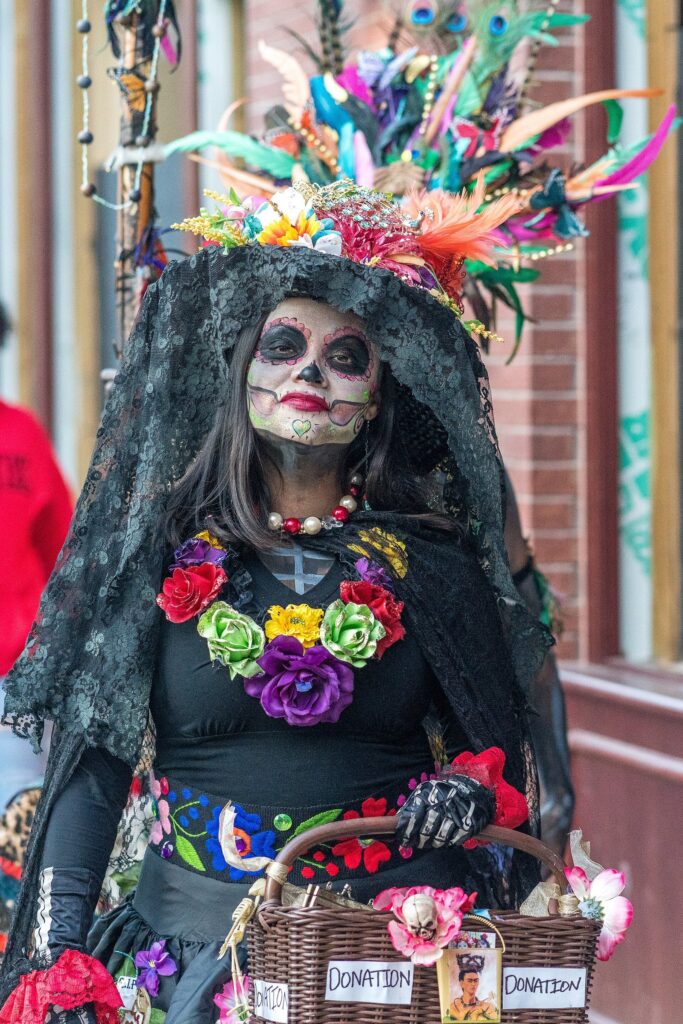
The elegant skeleton in a wide, flowered hat is La Calavera Catrina. The printmaker José Guadalupe Posada drew her in the early 1910s to mock Mexicans who aped European high fashion: a skull in a fancy hat, because death comes for everyone. Diego Rivera later painted her full-length, and gave her the name Catrina, in a 1947 mural in Mexico City. Today she’s the most recognizable Day of the Dead figure, and you’ll see Catrinas at every major event in town, often in elaborate dresses and face paint.
Alebrijes
The fantastical, brightly painted creatures, part jaguar, part dragon, part butterfly, are alebrijes. They began with the Mexico City artist Pedro Linares in the 1930s, who made them in papier-mâché, and carvers in Oaxaca later took up the form in wood. They aren’t an ancient part of the holiday, but they’ve become linked with it as spirit guides, and they’re the stars of the River Walk’s Tradition Trail, where 5-foot versions line the downtown banks.
Calaveras you read, not just look at
The word calavera has a second meaning: a short, funny poem written as a mock epitaph for someone still alive, often a politician or a celebrity, imagining how death came for them. These calaveras literarias show up in newspapers and school contests in Mexico every year around the holiday, and you may spot them pinned to altars or printed on festival posters. They’re the same joke as Posada’s Catrina, in verse: nobody, however grand, gets out of this alive.
The food of the season
Food is part of the welcome, both on the altar and at the table afterward. Pan de muerto is the one to try: a soft, sweet bread, often flavored with orange blossom or anise, topped with sugar and crossed with dough shaped like bones. Tamales are a fall and winter staple in San Antonio anyway, and they’re common on altars and at family gatherings. Look also for mole, the deep, complex sauce of chiles and spices, champurrado, a thick hot chocolate drink made with masa, and calabaza en tacha, pumpkin candied in piloncillo, the cone-shaped raw cane sugar. Panaderías across the city bake pan de muerto in the weeks around the holiday, and the vendors at the festivals sell plenty of all of it. For where to eat between events, see our San Antonio food guide.
How do you visit Día de los Muertos respectfully?
San Antonio’s public events are welcoming, and nobody expects visitors to know every custom. A few habits make the difference between a guest and a gawker:
- Look, don’t touch. Altars are memorials, not props. Don’t move, handle or take anything on them, including the food, the flowers and the sugar skulls, however tempting the pan de muerto looks.
- Read the photos. Each picture on an ofrenda is someone’s mother, child or friend. Take a moment with them before you take a picture of them.
- Ask before photographing people. Public altars at festivals are generally made to be seen, but people praying, crying or tending an altar are not part of the display. Costumed Catrinas usually enjoy being photographed, and asking first costs you nothing.
- Keep it a remembrance, not a horror show. Leave the zombie makeup, fake blood and “sexy skeleton” costumes for Halloween. Calavera face paint is common at the public events, and Market Square offers face painting, so if you wear it, wear it as part of the celebration.
- Contribute if you’re invited. Community altars sometimes welcome photos or names of visitors’ own loved ones; Muertos Fest’s Community Altar is on display all three days. Bring a printed photo if you’d like to remember someone, and follow the posted rules.
- Buy from the makers. The mercados at Muertos Fest and Market Square are full of local artists. A sugar skull, a print or a hand-painted alebrije bought from the person who made it is a better souvenir than a mass-produced mask.
- Treat churches and cemeteries as private. The four Spanish missions and San Fernando Cathedral are active Catholic parishes, and November 1 and 2 are holy days on their calendar. If you visit during a Mass, stay quiet at the back or come back later. Families decorating graves around November 2 are grieving, not performing; don’t wander cemeteries looking for a scene.
Muertos Fest at Hemisfair
Muertos Fest is the centerpiece of the season and the easiest place to see a lot of altars in one go. The 2026 festival runs Friday through Sunday, October 23 to 25, across Hemisfair, the park around the Tower of the Americas at the southeast edge of downtown. Admission is free.
The festival’s own page promises more than 80 handmade altars, a Community Altar on display all three days, and two processions. Its 2026 press release adds five stages of live entertainment, workshops, food and a Muertos Mercado with more than 75 art vendors. Friday opens with “¡Presente! A Night to Remember,” which begins with sensory-friendly hours from 5 to 7 p.m., a quieter window to see the altars, and continues with a fashion show of Día de los Muertos-inspired looks and music on the main stage.
Crowds are the main planning factor. The organizers expect more than 135,000 attendees over the weekend, and evenings are the busiest. If the altars are your priority, come for Friday’s sensory-friendly hours or right at Saturday’s 10 a.m. opening, then come back for the music after dark. October is mild, with an average high of 82°F, but it’s also one of San Antonio’s wetter months, so check the forecast and bring a light layer for the evening.
Plan it: free; Friday, October 23, 5 to 11 p.m. (sensory-friendly 5 to 7 p.m.); Saturday, October 24, 10 a.m. to 11 p.m.; Sunday, October 25, noon to 9 p.m.; procession times on the festival’s schedule; Hemisfair is about a 12-minute walk from Alamo Plaza.
The Day of the Dead River Parade
The parade turns the River Walk into a procession route: illuminated barges carrying altars, Catrinas, music and performers, moving down the river after dark. In 2026 it’s one night only, Friday, October 23, and it’s in its eighth year.
Tickets are on sale through the River Walk’s event page, with general admission and ADA seating. ADA seating is spread across nine sections, including the Tobin Center, Hotel Valencia, Main Plaza and the Arneson River Theatre. Children 2 and older need a ticket. Tickets are non-refundable and can’t be exchanged, so buy once your Friday night is certain.
You don’t have to buy a seat. A free, standing-room-only viewing area runs along the parade route, and chairs aren’t allowed there. Strollers, ice chests and carriers are banned from the parade, which matters if you’re bringing small children: plan on carrying them or watching from the street-level bridges. The River Walk’s page doesn’t list a start time or ticket prices, so check them when you buy. Our River Walk map guide shows where Main Plaza, the Arneson River Theatre and the elevators sit along the loop.
Plan it: Friday, October 23, 2026, after dark; ticketed seats (non-refundable, ages 2 and up) or free standing room; no strollers, ice chests, carriers or chairs in the standing area.
Día de los Muertos at Historic Market Square
Historic Market Square, El Mercado to many locals, holds its own celebration on Saturday and Sunday, October 24 and 25, from 10 a.m. to 6 p.m. Centro San Antonio’s listing describes traditional altars, cultural activities, face painting, mariachi and other live music, and local vendors. The highlight is the Las Monas Cultural Dance Procession, a procession of dance, costume and storytelling, from 1 to 2 p.m. both days.
If you can’t make the weekend, Market Square also runs a self-guided altar tour every day from 10 a.m. to 6 p.m. through November 7, with themed ofrendas set up around the square. It’s the best option for travelers arriving on the holiday itself, November 1 and 2, after the big festival has packed up. Market Square charges no admission and sits about a 19-minute walk from Alamo Plaza, west of downtown.
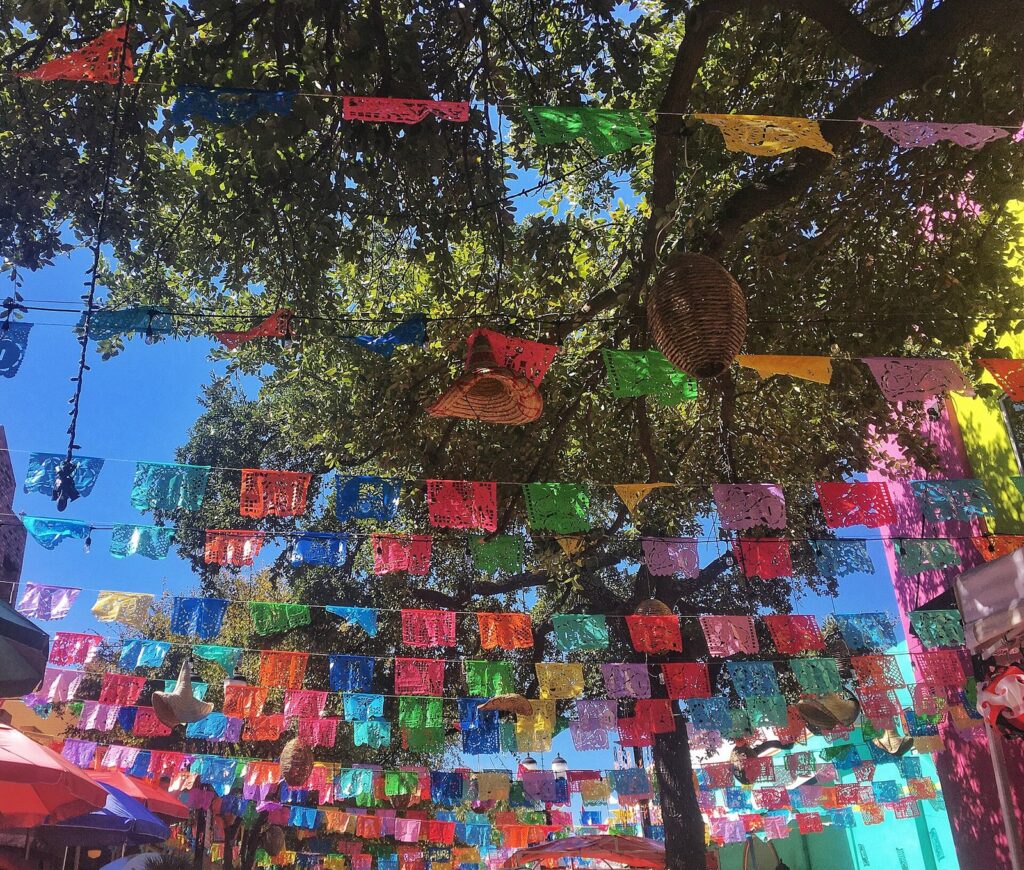
Plan it: free to walk in; Saturday and Sunday, October 24 and 25, 10 a.m. to 6 p.m.; Las Monas procession 1 to 2 p.m. both days; altar tour daily 10 a.m. to 6 p.m. through November 7; 514 W. Commerce St.
The Tradition Trail on the River Walk
From October 3 to November 2, 2026, the downtown River Walk becomes an open-air gallery. The River Walk’s listing describes 5-foot alebrijes, colorful calaveras and altars built by participating hotels, restaurants and businesses along the downtown stretch, and it’s free. The downtown River Walk is open 24 hours, so you can walk it whenever suits you: mornings are quieter and cooler, and after dark the lit installations look their best.
Go Rio River Cruises also lists a guided “Rio de la Vida” Tradition Trail Tour, a river cruise that explains the art and symbolism of the alebrijes, calaveras and ofrendas along the banks. If you’d rather sit than walk, it’s a good way to see the trail with context, but confirm the dates and fares with Go Rio before you go.
Plan it: free; October 3 to November 2, 2026; downtown River Walk, open 24 hours; the guided river tour costs extra.
How should you plan a Day of the Dead weekend?
The three main events overlap on Friday night and spread out over Saturday and Sunday. Here’s one way to fit them together without spending the whole weekend in a crowd.
| Day | Morning | Afternoon | Evening |
|---|---|---|---|
| Friday, October 23 | Arrive; walk the Tradition Trail on the River Walk | Rest before a late night | Muertos Fest’s sensory-friendly hours from 5 to 7 p.m., then the river parade |
| Saturday, October 24 | Muertos Fest’s altars at the 10 a.m. opening | Market Square, with the Las Monas procession at 1 p.m. | Back to Muertos Fest for music, or the Tradition Trail after dark |
| Sunday, October 25 | A mission visit, quietly, around Mass times | Market Square’s altars or Muertos Fest from noon | Muertos Fest’s last night, until 9 p.m. |
On Friday, check the parade’s start time when you buy tickets, because Muertos Fest and the parade both run that evening. Hemisfair, the River Walk loop and Market Square are all within walking distance of each other, but Market Square is the outlier on the west side, so group your visits by area.
Where to stay and how to get around
Downtown hotels near the River Walk put you within walking distance of all three events, which is worth a lot on a festival weekend. If you’re driving in, park once and walk. VIA buses cover downtown, and our guide to getting around San Antonio has fares, garages and rideshare drop-off tips. For an accessible route to the river, use the elevators the City marks on its River Walk map rather than the stairs at the bridges.
If you’re here on November 1 and 2
The public festivals are over by then, but the season isn’t. The Tradition Trail runs through November 2 and the Market Square altar tour through November 7. This is also when the holiday is most personal: churches hold All Saints’ and All Souls’ Masses, and families visit cemeteries. It’s a quieter, more reflective time to be in town, and a good one for looking slowly at altars without a crowd.
Where else can you see Día de los Muertos art?
Beyond the big three, altars appear in hotel lobbies, restaurants and shops across downtown during the season, many of them part of the Tradition Trail. On the Westside, the Guadalupe Cultural Arts Center, founded in 1980 to promote Chicano, Latino and Native American arts, is worth checking for exhibitions and events. Market Square’s shops are a good place to look for papel picado and folk art. For the longer story of the city’s Indigenous, Spanish, Mexican and Tejano roots, read our guide to San Antonio culture and history.
And if you’re building a trip around the season, our guide to San Antonio’s festivals and seasonal events covers the rest of the fall calendar, from Luminaria to the start of the holiday lights.
San Antonio Día de los Muertos FAQ
When is Day of the Dead in San Antonio in 2026?
The holiday itself is November 1 and 2, but San Antonio’s big public weekend comes earlier: Muertos Fest runs October 23 to 25, the river parade is Friday, October 23, and Market Square celebrates October 24 and 25. The River Walk’s Tradition Trail runs from October 3 to November 2, and Market Square’s altar tour lasts through November 7.
Is Muertos Fest free?
Yes. Muertos Fest at Hemisfair is free to attend. It runs Friday, October 23, from 5 to 11 p.m., Saturday from 10 a.m. to 11 p.m. and Sunday from noon to 9 p.m. Food, drinks and art from the vendors cost extra. Friday’s first two hours, 5 to 7 p.m., are set aside as sensory-friendly time.
Do you need tickets for the Day of the Dead River Parade?
Only for a seat. Ticketed general admission and ADA seating are sold online, children 2 and older need their own ticket, and tickets can’t be refunded or exchanged. There’s also a free, standing-room-only viewing area along the route. Chairs, strollers, ice chests and carriers aren’t allowed.
Is it disrespectful to wear calavera face paint?
Not at San Antonio’s public celebrations, where face painting is offered and plenty of people wear it. What matters is the spirit: wear it as part of a remembrance, not as a horror costume, and don’t pair it with gore or a joke outfit. At a family altar, a church or a cemetery, leave the costume behind.
Is Day of the Dead the same as Halloween?
No. They fall close together, but Halloween plays with fear, while Día de los Muertos honors people who have died and welcomes their memory home. The skulls are cheerful, the altars are memorials, and the mood is closer to a family reunion than a haunted house. In San Antonio, both run side by side in late October.
Can you bring children to the Day of the Dead events?
Yes, and many local families do. Muertos Fest’s sensory-friendly hours on Friday, 5 to 7 p.m., suit younger kids, and Market Square’s daytime celebration is easy with a family. The river parade is harder: strollers and carriers are banned, children 2 and older need a ticket for seats, and it runs after dark.
Related San Antonio Guides
- San Antonio River Walk Map: where the parade seating areas, the elevators and the Tradition Trail stretch sit.
- San Antonio Culture and History: the Indigenous, Spanish, Mexican and Tejano story behind the city’s traditions.
- Shopping in San Antonio: Market Square and where to buy folk art from local makers.
- San Antonio Food: Tex-Mex, panaderías and where to eat between events.
- San Antonio Missions Guide: the four active mission churches, and how to visit them respectfully.
Sources and How We Checked
This guide was checked on October 1, 2026 and is compiled from the event organizers and agencies listed below, not from other travel lists. Event details change from year to year, so confirm times on the organizers’ pages before you go. It describes events from those sources and claims no first-hand visits.
- Muertos Fest: Festival dates, hours and program
- San Antonio River Walk: Day of the Dead River Parade, Día de los Muertos Tradition Trail
- Centro San Antonio: Día de los Muertos at Historic Market Square
- City of San Antonio: Historic Market Square
- Texas Public Radio: San Antonio’s growing reputation as a Day of the Dead destination (2025)
- Texas State Historical Association, Handbook of Texas: Guadalupe Cultural Arts Center
- NOAA National Centers for Environmental Information: San Antonio monthly normals, 1991 to 2020
- OpenStreetMap: walking routes from Alamo Plaza
San Antonio Tourism Guide is an independent publication. We are not affiliated with Visit San Antonio, the City of San Antonio, the Alamo or any attraction listed here, and no one paid to be included.
Photo Credits
- Day of the Dead ofrenda at Mission Marquee Plaza: photo by NPS Photo, Wikimedia Commons (Public domain)
- Blessing of Día de los Muertos altars: photo by NPS Photo, Wikimedia Commons (Public domain)
- La Catrina costume: photo by Nan Palmero from San Antonio, TX, USA, Wikimedia Commons (CC BY 2.0)
- Papel picado at Historic Market Square: photo by H. Michael Karshis, Wikimedia Commons (CC BY 2.0)